Every site on one map.
See each site and its status at a glance, then open the one that needs attention instead of sending someone to find out.
Built in collaboration with Comlab: remote site management that keeps communications reliable and secure for emergency services and critical infrastructure.
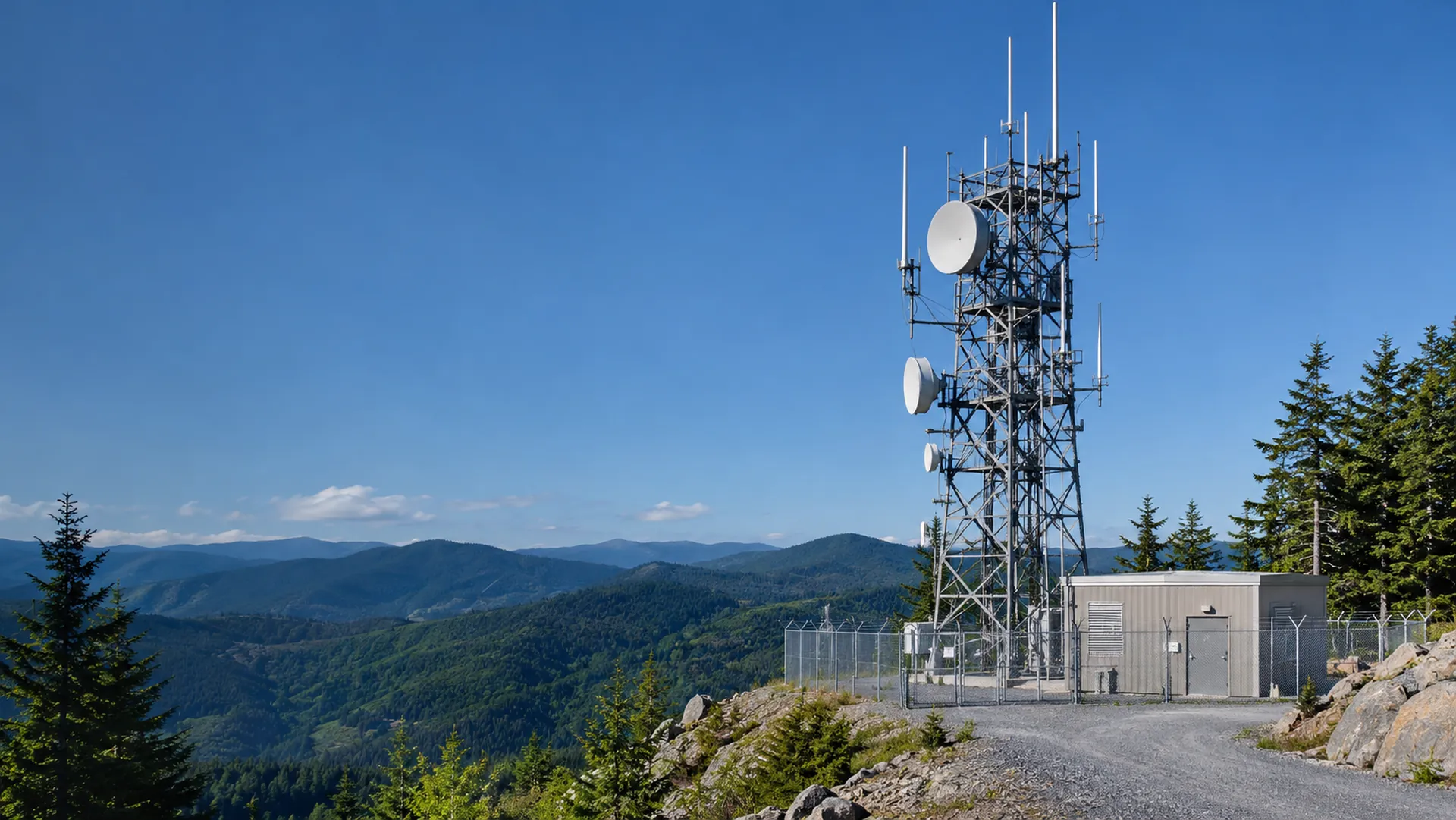
A repeater site is more than radios. It includes generators, UPS systems, HVAC units, batteries and the repeaters themselves. When sites are spread out and hard to reach, every truck roll is expensive.
With each site reporting in, technicians know what failed before they leave. You bring the right parts, avoid wasted trips and fix issues faster, which matters in a constrained labor market.
Repeaters.Generators.Batteries.Tower lights.
A state network with more than 200 sites now has real-time visibility and automated alerts, so critical communications stay available.
State Public Safety Network
See each site and its status at a glance, then open the one that needs attention instead of sending someone to find out.
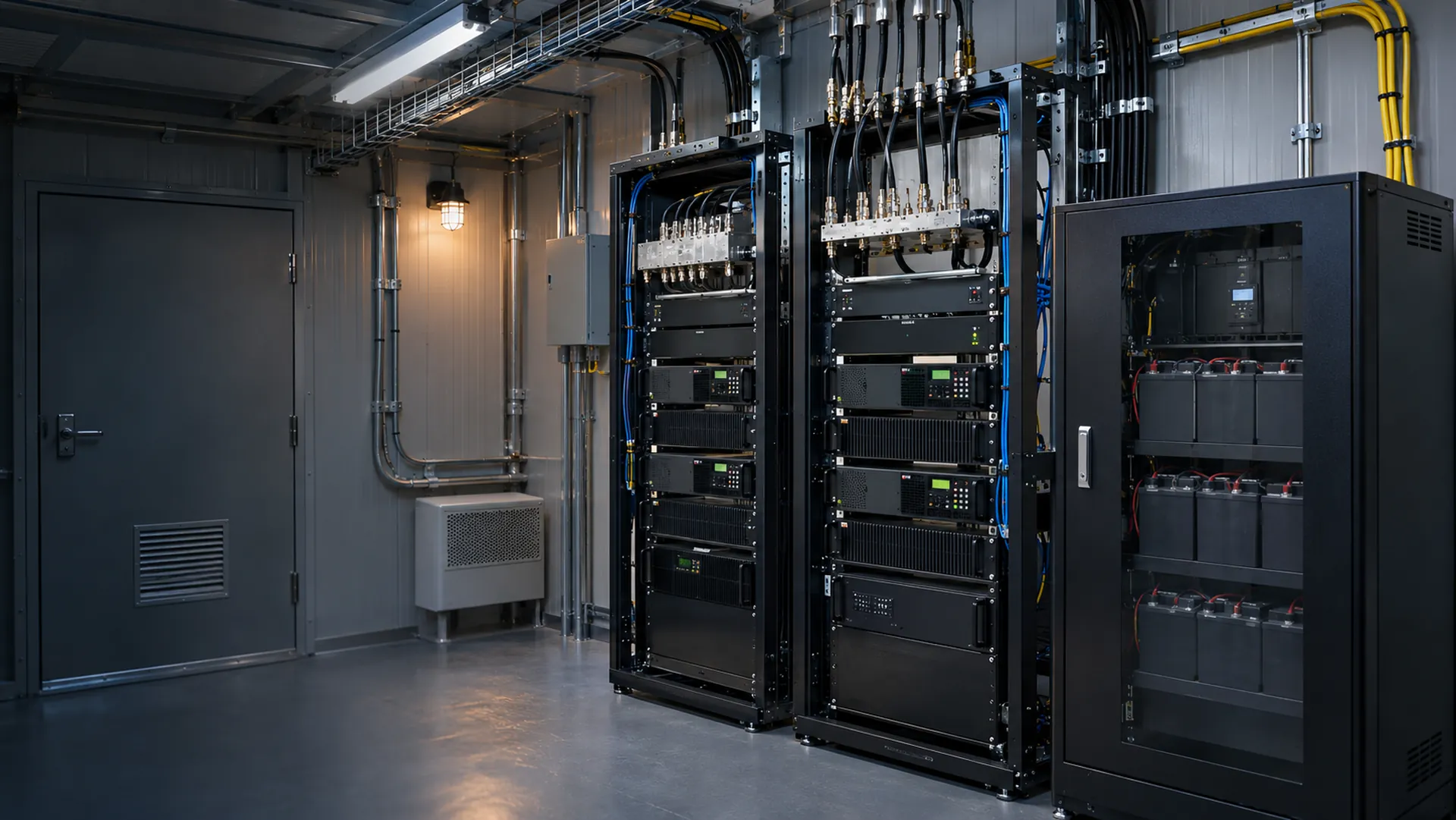
An RTU connects all on-site equipment and streams alarms and data to you, the NMS or both. It's the local intelligence, monitoring, logging and running automations around the clock.
Monitor Tait, Motorola, Kenwood, Icom and EF Johnson repeaters through SNMP where supported, or with RF power sensors and PTT qualifiers. Track forward and reflected power, and detect antenna or equipment issues early.
Track light status, photoresistors and current flow to detect failures and maintain compliance.
Verify utility power and transfer to UPS or generators. Monitor runtime, fuel, start signals and ATS status through local I/O, SNMP or Modbus.
Integrate SNMP-enabled UPS units for charge, voltage, load, runtime and faults, by polling or traps.
Track RSSI, BER, link status and radio health through SNMP or GPIO for backhaul assurance.
Monitor breaker states, current levels and bus voltages to detect anomalies early.
Temperature, humidity, smoke, water intrusion, lightning detection and more.
The solution installs an autonomous RTU at each repeater site, with an optional central network management system (NMS) at the NOC. Each RTU continuously monitors local equipment and sends alarms and data to the NMS or directly to technicians, depending on your setup. If a communication link fails, sites continue operating locally.
Mosaic consolidates site data into one interface for monitoring, alarm management and rapid access to site details. Alarm logic and automations stay at the RTU, for resiliency.
Davicom is our partner for RTUs, and Mosaic is pre-integrated with every series below.
A 1U, 19-inch rack-mount platform with five independent slots for NIO cards. It shares its core and interface with AXON, and suits sites that need more I/O.
Mosaic centralizes statuses and alarms from AXON, NEURO and Davicom CORTEX units. Install it on Windows or Linux, on premises or in the cloud.
See site health with color-coded alarms and symbols. Add layers such as precipitation, cloud coverage and wind, and jump to any RTU's web interface from the map.
View, acknowledge, filter and sort alarms in real time. Configure thresholds, rules and escalations, with audio cues and annotations.
Group readings across sites, such as generators or VSWR at all locations. Aggregate and trend data to detect patterns and inform maintenance.
Generate alarm reports in PDF, HTML, DOCX, XLSX or CSV, on demand or on a schedule, with counts and durations for a time range.
Simultaneous connections with access levels. Add a backup server for uninterrupted operation.
A condensed view. See the full comparison from Davicom.
| Capability | AXON | NEURO | CORTEX 320 | CORTEX 360 |
|---|---|---|---|---|
| Analog inputs | Up to 40 (see AXON specs) | Up to 40 (see AXON specs) | 12 single-ended (0-5 V or 0-60 V) | 8 bipolar or differential (±0.5 V to ±80 V; 4-20 mA) |
| Digital inputs | 8 (AXON-8D); ±65 V | 4 | 16 | — |
| Relays | 5 (AXON-5R); up to 10 with expansion | 6 (3 Form C, 3 Form A/B) | 8 Form C | 8 Form C |
| Virtual logic | 4 jobs, 8 math, schedulers, counters, activity monitors | Same as AXON | 16 math and 128 virtual gates or relays | 32 math and 128 virtual gates or relays |
| SNMP agent | v1, v2c, v3 | v1, v2c, v3 | v1, v2c, v3 and manager (8 commands; up to 256) | v1, v2c, v3 and manager (128 commands; up to 1,024) |
| Modbus master | — | — | 8 slaves (up to 32) | 8 slaves (up to 32) |
| Networking | Ethernet, cellular, satellite | Ethernet, cellular, satellite | Dial-up, Ethernet, cellular, satellite, 2-way radio | Dial-up, Ethernet, cellular, satellite, 2-way radio |
An RTU connects all on-site equipment and sends alarms and data to you or the NMS. It monitors, logs and runs automations locally, around the clock.
Sites continue operating locally. Each RTU keeps monitoring and acting on its own, because alarm logic and automations stay at the RTU.
Yes. Davicom RTUs support SNMP and can integrate into existing systems.
Mosaic installs on Windows or Linux, on premises or in the cloud.